Know what was agreed, who decided it, and whether it was delivered.
ClarixERR keeps every enterprise requirement in one governed record, traced from the goal behind it to the work that delivered it, so audits, change decisions and handovers stop depending on who remembers.
No cost during early access. No payment details.
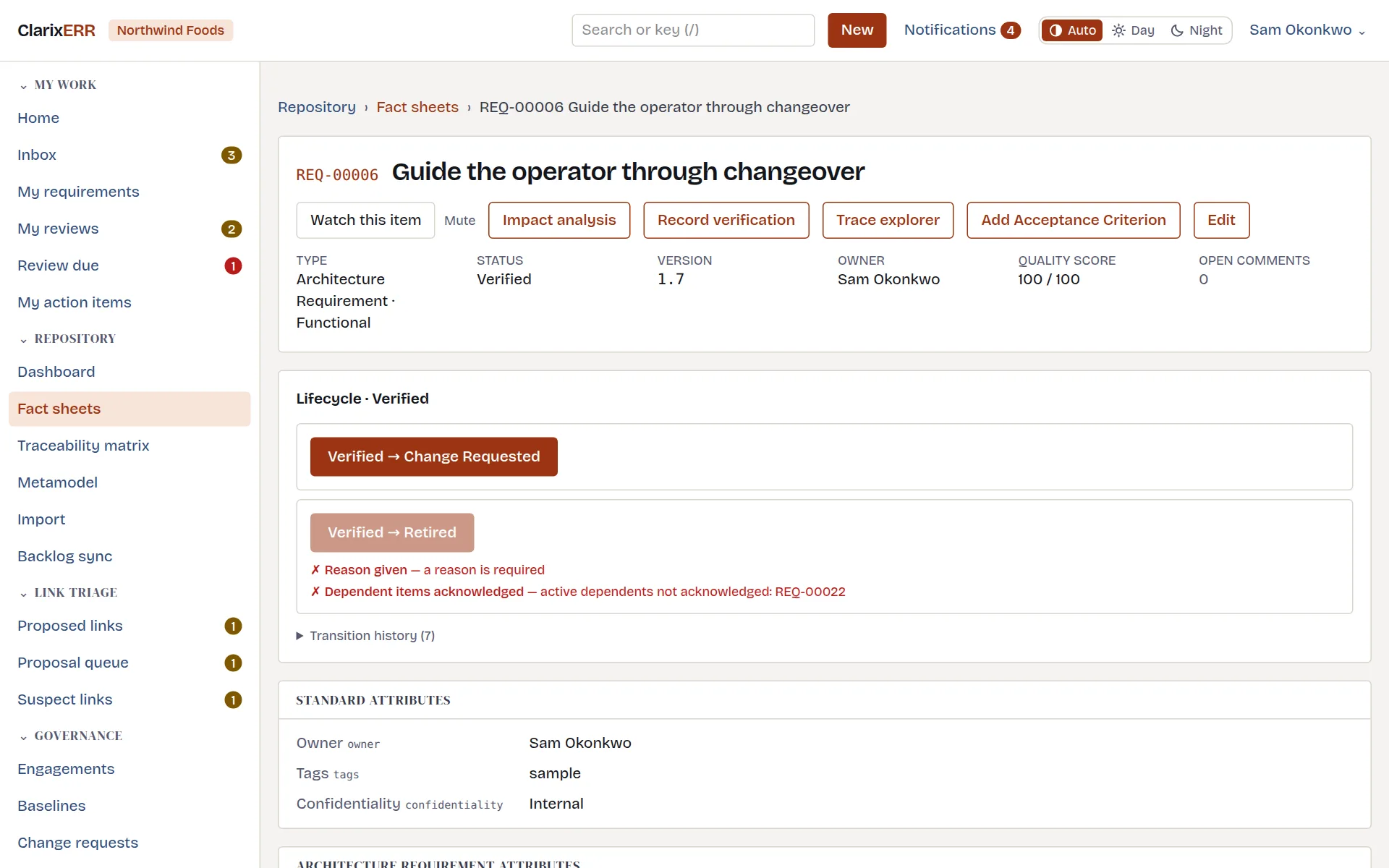
Most organizations cannot say which requirements were approved, what changed, or what was delivered.
Requirements sit in slide decks, spreadsheets, and ticket systems. Approval happens in email. Traceability is rebuilt by hand for each audit and abandoned after go-live. The cost shows up as rework, scope disputes, and compliance findings.
How it works
- CaptureWrite requirements from templates, import the spreadsheets you already have, or triage rough notes into structured fact sheets.
- GovernRoute each one through review and approval under policies your organization defines, with the decider's capacity recorded.
- BaselineFreeze an approved set. Changes after that point go through a change request with a recorded decision.
- Trace and deliverLink each requirement to the goal behind it and the work that delivers it, keep your backlog tool in step, and generate the specification from what was approved.
What it does
Decisions that outlive the people who made them
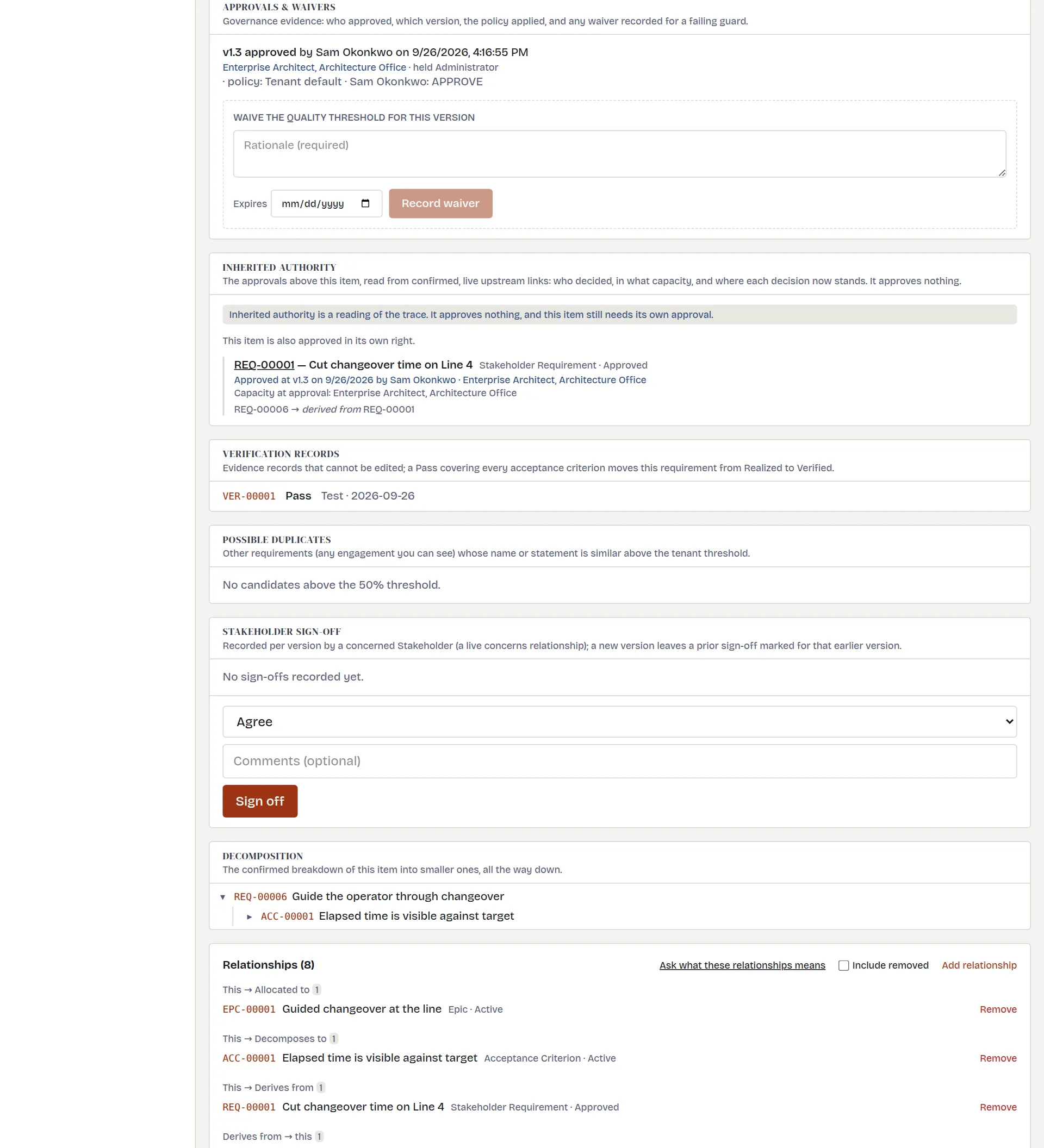
Every approval records who decided, in what capacity and under which policy. When a decider leaves, the record shows who holds that seat now.
Specifications generated, not rewritten
Produce the architecture requirements specification and the change impact report from the approved record, at the versions that were approved.
Backlog and architecture tools kept in step
Epics and stories are created in your backlog tool with the requirement they trace to; status and sprint come back. An edit made there waits for a person instead of being overwritten.
End-to-end traceability
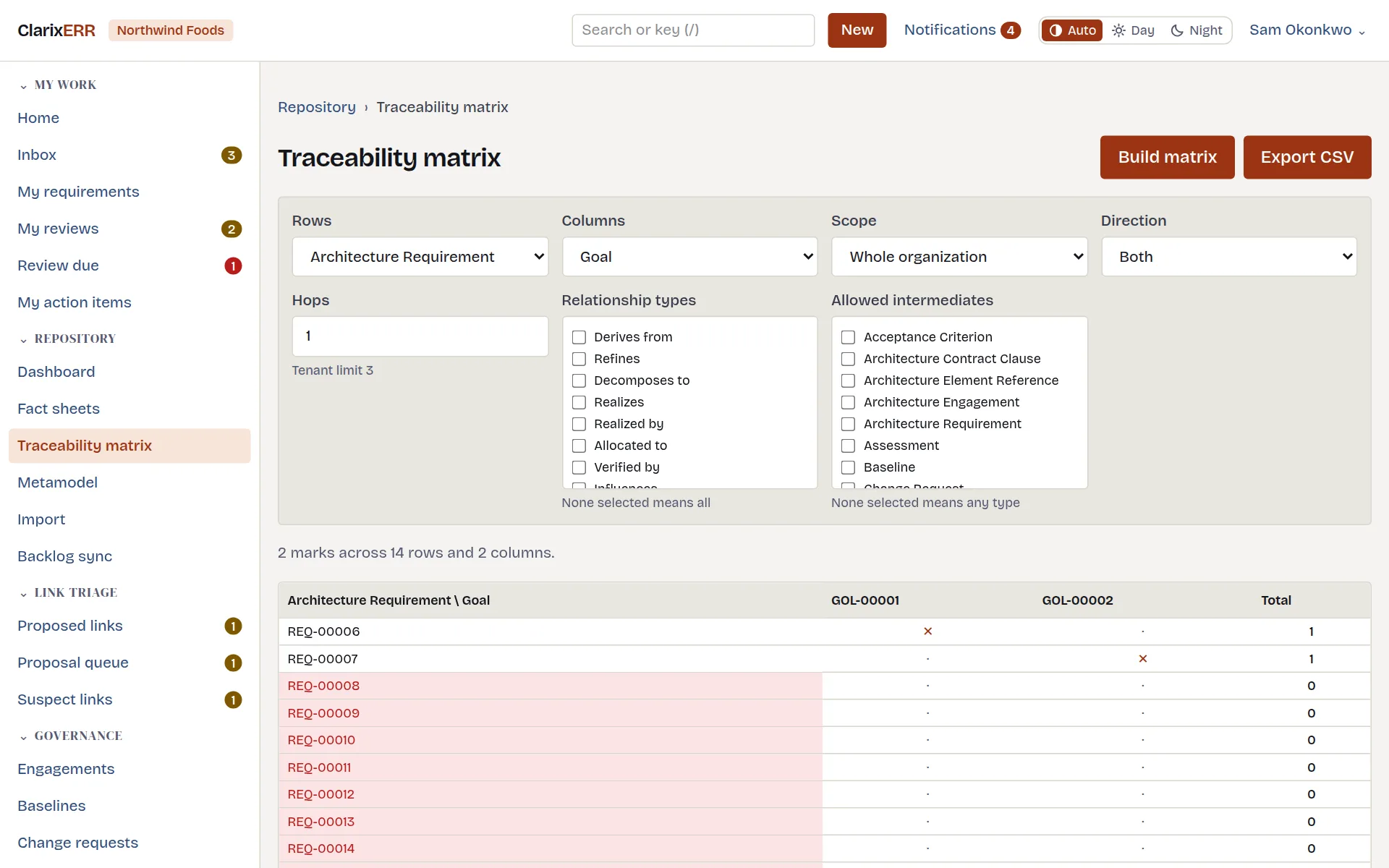
A matrix from motivation to verification. Links that may be invalidated by a change are flagged as suspect for re-confirmation.
Baselines and change control
Approved sets are frozen. Change requests carry rationale, impact, and a decision. Requirements come back for review on a cadence set by how volatile they are.
Review and approval
Review policies, reviewer queues, reminders, follow-up actions, and a recorded outcome for every decision.
Quality rules and templates
Requirement and deliverable templates, organization vocabularies, and quality rules that hold requirements to a standard, including technology-agnostic wording.
Structured fact sheets
Every requirement has a type, attributes, a lifecycle, and an owner, defined by a metamodel you can inspect.
Complete audit trail
Every change is recorded, searchable, and exportable.
Who it is for
Enterprise architects
Requirements tied to drivers, goals, and architecture work, in a structure aligned with TOGAF requirements management and viewed by ADM phase, with the specification generated from an approved baseline.
Business analysts
Templates, imports, and review queues that fit project delivery, including Agile teams working from user stories, with stories kept in step with the backlog tool.
Governance, PMO, and compliance leads
Baselines, change decisions, compliance reviews, and an exportable audit log, with every approval recording the capacity it was made in.
Load the sample engagement and see your own role's view of it before you enter anything of your own.
Built for people and AI agents working in the same repository.
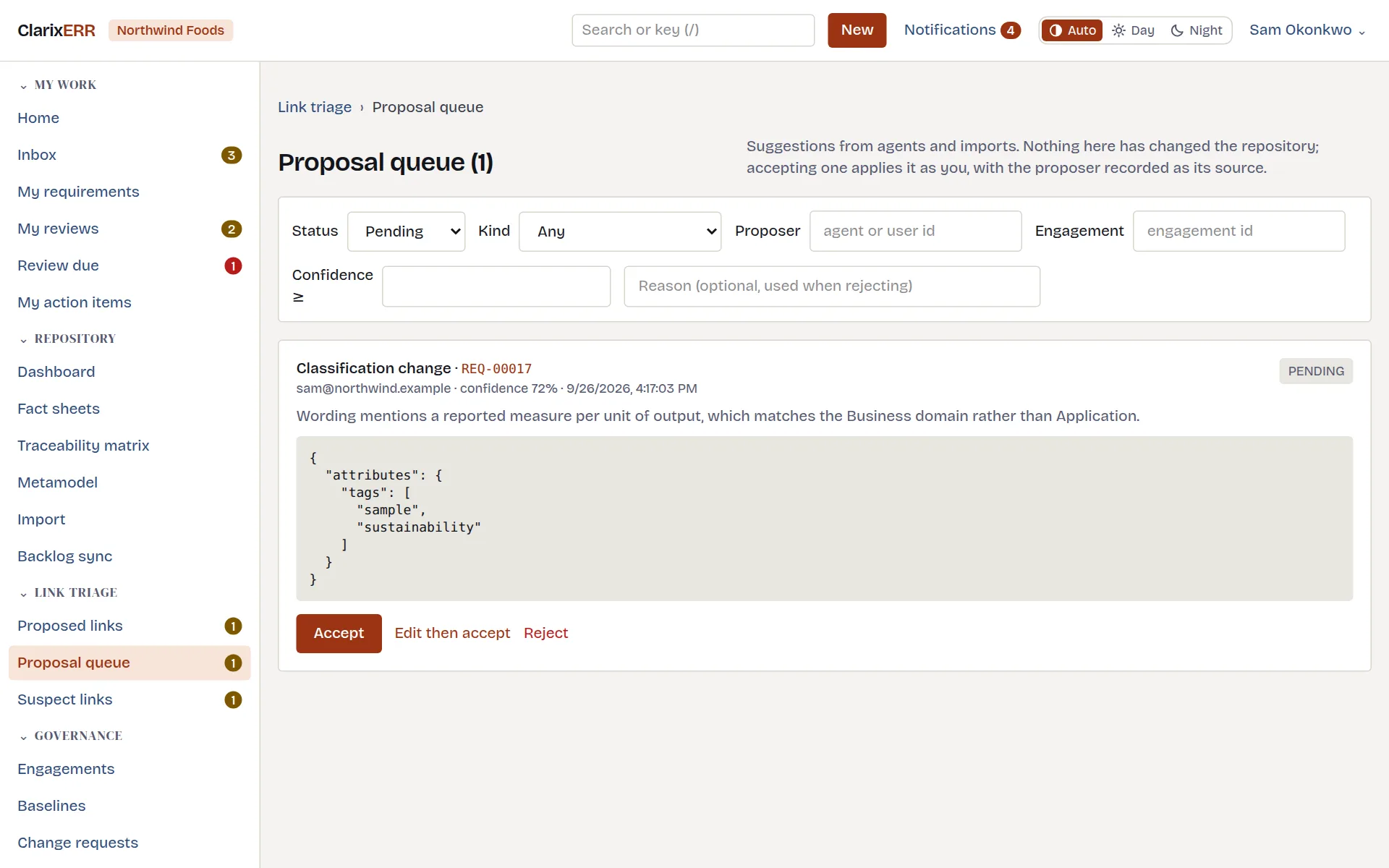
Agents get their own identities, scoped API tokens, and the same audit trail as people. An agent can propose requirements and links; a person decides what is accepted. External agents connect over the Model Context Protocol and are offered only what their token already permits. Event subscriptions let other systems react to changes.
Working alongside other systems
Architecture elements, work packages, initiatives and contract clauses mastered elsewhere can be represented as shadows, with mastership defined per record type, so traces stay complete without duplicating ownership.
How your data is protected
Each organization's data is isolated. Access is controlled by roles and granular permissions. Every change is logged.
Details on the Security pageStand up your requirements repository today.
In your first ten minutes: create an organization, load the sample engagement, and follow one requirement from the goal behind it to the verification that closed it. Remove the sample in one step when you are ready for your own.